

Short answer: AEO (Answer Engine Optimization) is optimizing your content so search engines and voice assistants can pull it as a direct answer. GEO (Generative Engine Optimization) is optimizing your brand and content so AI tools such as Google AI Overviews, ChatGPT, Perplexity, Gemini and Claude understand, trust and mention your business in the answers they generate.
The way people search is changing. Instead of typing a few keywords and scrolling through ten blue links, more people now ask full questions and read a single summarized answer, whether in Google’s AI Overviews or in an AI assistant. If your business is not part of those answers, you may miss potential customers even when your website ranks well. This guide explains what AEO and GEO mean, how AI tools choose their sources and what practical steps you can take today.
How search is changing
Traditional search results show a list of pages and let the user decide which one to open. Answer engines and generative AI tools do more of that work themselves. They read many sources, combine the information and present a direct answer, often with a few cited links. For businesses, this creates a new goal: not only ranking on page one, but being one of the sources the answer is built from, or being the business the AI recommends.
SEO vs AEO vs GEO
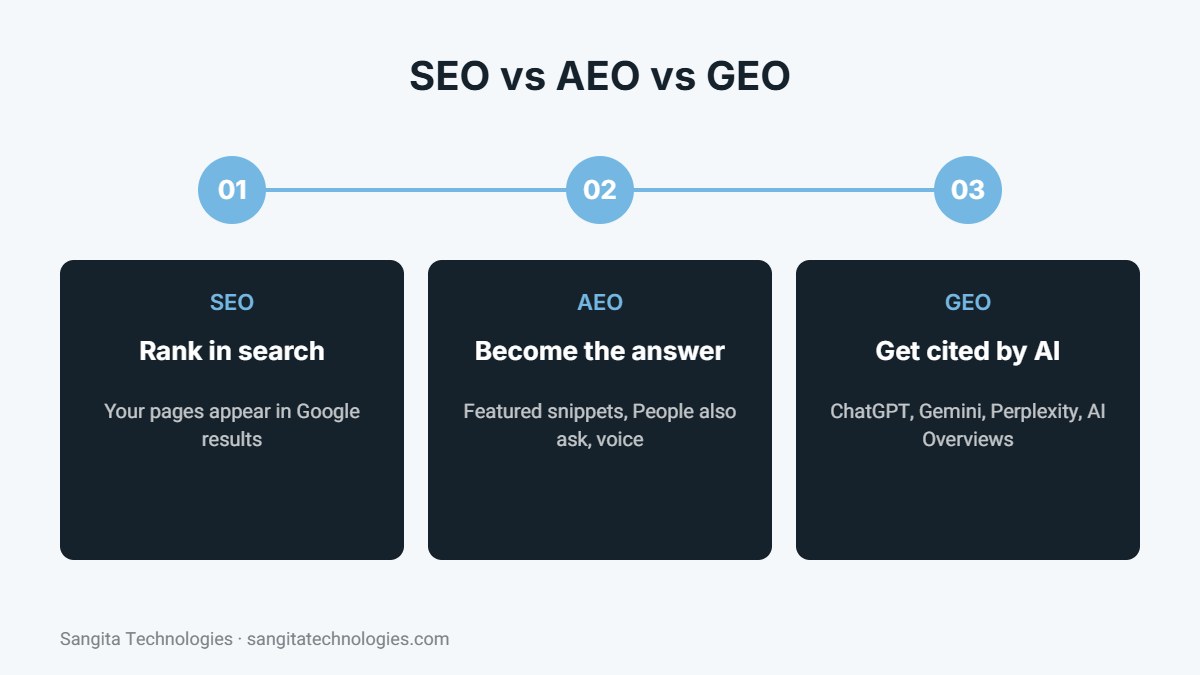
- SEO helps your pages rank in search results so people click through to your website.
- AEO helps your content become the direct answer in featured snippets, “People also ask” boxes and voice search results.
- GEO helps AI models understand your brand and cite or recommend it in generated answers.
All three share the same foundation: a technically healthy website with helpful, trustworthy and clearly structured content. AEO and GEO do not replace SEO; they build on it.
How AI answer engines choose their sources
AI tools usually combine information from search indexes and from websites they can crawl. While each tool works differently, they tend to favour content that is:
- Clear and direct: it answers the question plainly, without making readers search for the point.
- Well structured: headings, lists, tables and short paragraphs make it easy to extract information.
- Factual and specific: real details, examples and explanations are more useful than vague marketing language.
- Consistent across the web: the same business information appears on your website, profiles and directories.
- From trusted sources: websites with good reputations, reviews and mentions from other sites are more likely to be used.
- Accessible: if your robots.txt blocks crawlers, those tools cannot read your content.
10 practical ways to optimize for AEO and GEO
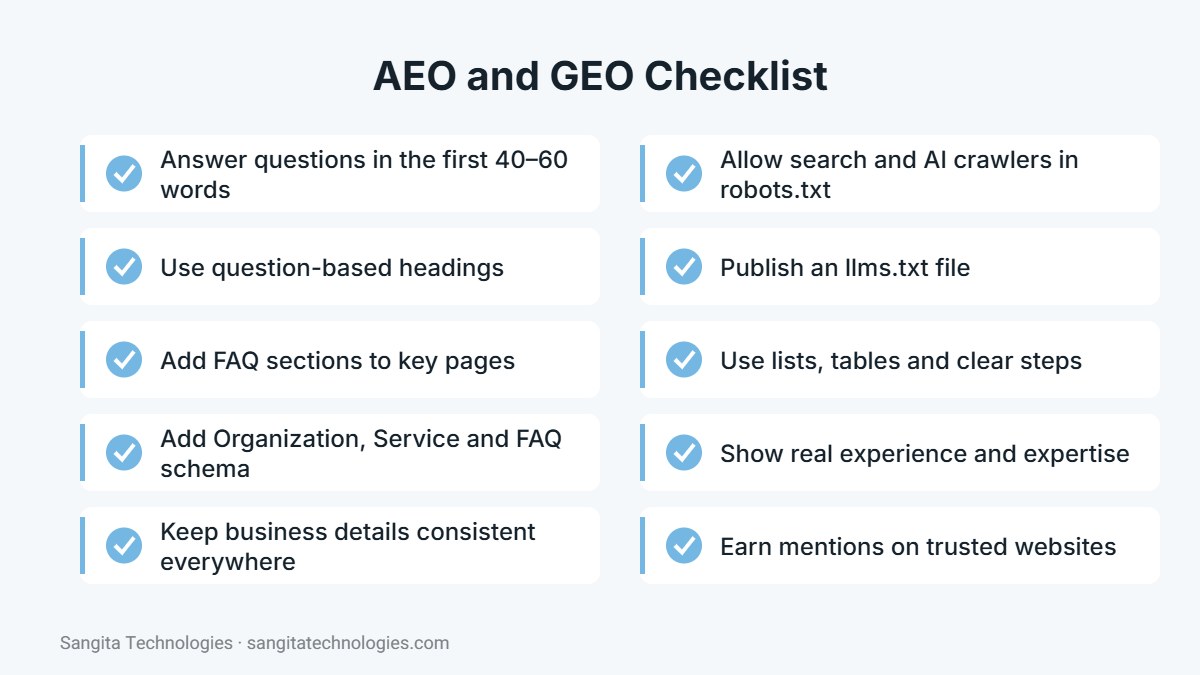
1. Answer questions directly
Start pages and sections with a short, clear answer of around 40 to 60 words, then add detail below. This “answer first” format is easy for search engines and AI tools to quote.
2. Use question-based headings
Write headings the way customers ask questions, such as “How long does SEO take?” or “What is included in website maintenance?”. This matches how people search and speak to voice assistants.
3. Add FAQ sections to key pages
Collect the real questions customers ask on calls, emails and WhatsApp, and answer them on the relevant service pages. Each answer should be complete on its own.
4. Use structured data
Schema markup such as Organization, LocalBusiness, Service, FAQPage and Article tells machines exactly what your content is about, who you are and what you offer.
5. Keep business details consistent everywhere
Your business name, address, phone number, services and description should match on your website, Google Business Profile, directories and social profiles. Inconsistent information makes it harder for AI tools to trust any single version.
6. Build a clear entity profile
Your About page should include key facts about your business: what you do, where you are, who you serve and how to contact you. Link to your official social profiles so AI tools can connect them to your brand.
7. Allow search and AI crawlers
Check that robots.txt does not block the search and AI bots you want to be visible in. Consider adding an llms.txt file that summarizes your website and links to your most important pages.
8. Use lists, tables and clear steps
Structured formats are easy to read and easy to quote. Comparison tables, checklists and numbered steps work especially well.
9. Show real experience and expertise
Share practical examples, case studies, processes and lessons from your own work. Avoid exaggerated claims that cannot be verified.
10. Earn mentions on other websites
Genuine reviews, directory listings, partner websites, interviews and industry articles all help AI tools see your business as credible and relevant.
How to check if AI tools mention your business
Ask ChatGPT, Perplexity, Gemini and Google’s AI Overviews the questions your customers ask, such as “best digital marketing agency in Jaipur” or “who offers WordPress development in Jaipur”. Note which businesses appear and which websites are cited as sources. Repeat every few months to see whether your visibility is improving, and look at the cited sources for ideas on where your business should also be mentioned.
What we have done on our own website
At Sangita Technologies, we apply these practices on our own site. Our service pages include answer-first FAQ sections; we use Organization, LocalBusiness, Service and FAQPage schema; we publish an llms.txt file; our About page includes a company facts table; and our robots.txt allows search and AI crawlers to read our content.
Conclusion
AEO and GEO build on strong SEO. By answering questions clearly, structuring your content, using schema and keeping your business information consistent everywhere, you make it easier for both search engines and AI assistants to understand and recommend you. The businesses that prepare now will be better placed as AI search continues to grow.
Want help preparing your website for AI search? Call Sangita Technologies on +91 97855 41763 for a free AEO and GEO review.

Written by the Sangita Technologies team
Sangita Technologies is a digital marketing and web development agency in Jaipur, Rajasthan. Our team works hands-on with local and national businesses on SEO, local SEO, Google Ads, social media marketing, content writing, WordPress and e-commerce development, and shares practical lessons from that work on this blog.
Related services from Sangita Technologies
Sources and further reading
- Google Search Central: Introduction to structured data
- Google Search Central: Creating helpful, reliable, people-first content
- llms.txt proposal
Frequently Asked Questions
Is GEO replacing SEO?
No. GEO builds on SEO. AI tools still rely heavily on search indexes and well-optimized websites, so strong SEO remains the foundation for appearing in AI answers.
What is llms.txt?
llms.txt is a simple text file placed at the root of a website that summarizes the site and links to its most important pages, helping large language models understand the content.
Does FAQ schema still help?
Google now shows FAQ rich results for very few websites, but FAQ schema still helps search engines and AI tools understand your questions and answers clearly.
How long does it take to appear in AI answers?
It varies. AI tools update their sources at different speeds. Improving content, schema and brand mentions usually shows effects over several months, similar to SEO.