

Short answer: Google Ads is usually better for capturing people who are already searching for your product or service, while Meta Ads (Facebook and Instagram) are better for creating demand by reaching people based on their interests, demographics and behaviour before they search. Many businesses get the best results by using Google Ads for high-intent leads and Meta Ads for awareness, remarketing and visual offers.
If you have a limited advertising budget, choosing the right platform is important. Both Meta and Google offer powerful targeting and measurable results, but they work in very different ways. This guide compares them in practical terms so you can decide where to start and how to combine them as you grow.
How Google Ads works
Google Ads shows your ads to people when they search on Google, watch YouTube or browse websites in Google’s network. Search ads are triggered by keywords, so they reach people who are actively looking for something, such as “AC repair in Jaipur” or “buy office chairs online”. Because the intent is high, search ads often generate leads that are ready to act.
How Meta Ads works
Meta Ads show your ads on Facebook, Instagram, Messenger and partner apps. Instead of keywords, you target people by location, age, interests, behaviour and lookalike audiences similar to your existing customers. People are not searching for you at that moment; they are scrolling, so your ad needs to catch attention and create interest.
Intent: searching vs discovering
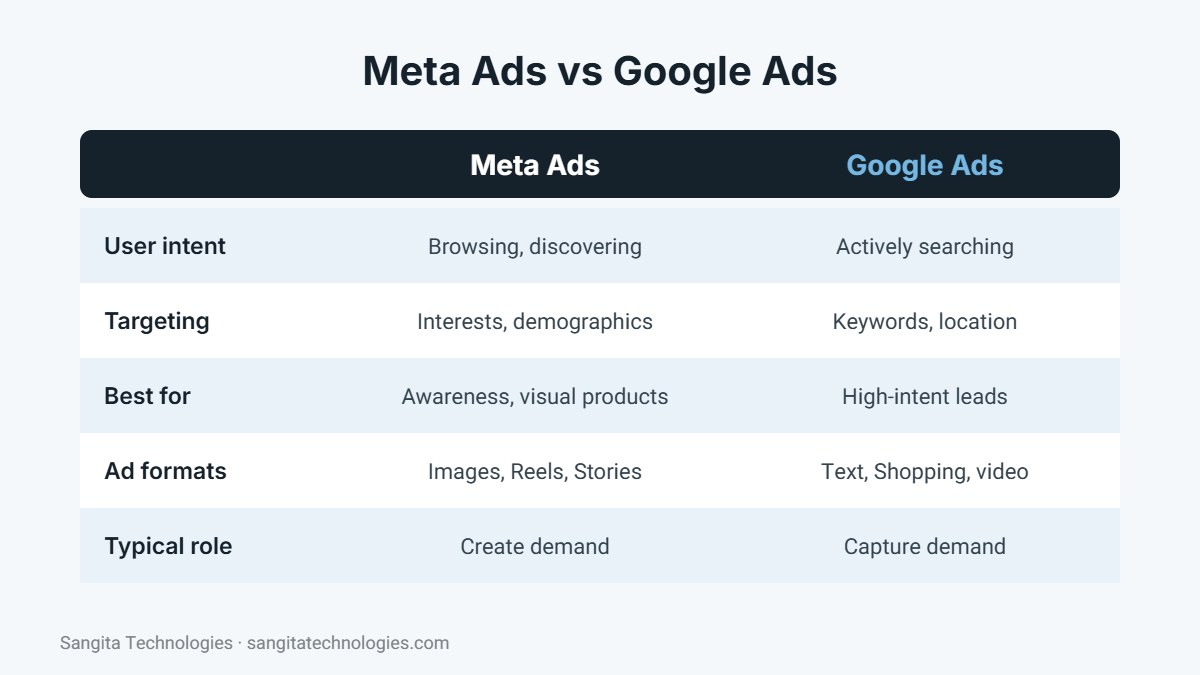
This is the most important difference. Someone searching on Google has already identified a need. Someone scrolling Instagram may not have thought about your product until they saw your ad. Google Ads captures existing demand, while Meta Ads can create new demand.
Targeting options
Google Ads targeting is built around keywords, locations, devices and schedules, plus audiences for Display and YouTube. Meta Ads offers rich demographic and interest targeting and excellent lookalike audiences, which are especially useful when your product appeals to a specific type of person.
Ad formats and creative
Google Search ads are mainly text, with extras such as sitelinks, phone numbers and images. Shopping ads show products with prices. Meta Ads are highly visual: images, carousels, Reels and Stories. If your product looks great in photos or video, Meta can be very effective. If customers compare options by searching, Google usually wins.
Cost and results
Costs vary by industry, competition and location on both platforms. Google search clicks can be more expensive in competitive industries, but the leads tend to be more ready to buy. Meta often delivers lower-cost reach and clicks, but some of those people are earlier in their decision. The right comparison is not cost per click, but cost per lead and cost per customer.
Which businesses suit each platform?
Google Ads is often the better starting point for
- Urgent services, such as repairs, emergency services and clinics.
- B2B services where buyers search for solutions.
- Professional services like legal, accounting, SEO and web development.
- Online stores selling products people search for by name.
Meta Ads is often the better starting point for
- Fashion, beauty, food, lifestyle and home decor brands.
- Restaurants, cafes, gyms and salons targeting nearby audiences.
- Events, launches, offers and new products people do not yet know about.
- Education and coaching with visual success stories.
Using both together
Many successful campaigns combine the two. Meta Ads build awareness and interest; later, those people search on Google and see your search ads. Both platforms also allow remarketing, showing ads to people who visited your website but did not contact you, which often produces some of the cheapest conversions.
Tracking is essential
Whichever platform you choose, set up conversion tracking before spending significant budget: the Google tag and conversion actions for Google Ads, and the Meta Pixel and Conversions API for Meta. Track calls, form submissions, WhatsApp clicks and purchases so you can compare the platforms fairly.
A practical way to start
- Define your goal: leads, sales, bookings or awareness.
- Start with the platform that matches your customers’ behaviour.
- Run a small test budget for three to four weeks with tracking in place.
- Compare cost per lead and lead quality.
- Scale the winner and test the other platform for remarketing or awareness.
Remarketing: getting a second chance
Most people do not contact a business on their first visit. Remarketing lets you show ads to people who have already visited your website, watched your videos or engaged with your Instagram profile. Because they already know you, these ads often convert at a lower cost than ads to new audiences.
- On Meta: create custom audiences of website visitors, Instagram engagers and video viewers, then show them testimonials, offers or reminders.
- On Google: use remarketing lists in Display and YouTube campaigns, and in search campaigns to bid higher for returning visitors.
- Keep it relevant: show different messages to people who viewed different services, and limit how often ads are shown so they do not become annoying.
Budget split for beginners
If you are unsure how to divide your budget, start by putting most of it into the platform that best matches how your customers find you, and keep a smaller share for testing the other platform and remarketing. After a month, compare cost per lead and lead quality, then shift budget towards what works. Review results monthly, because costs and performance change with seasons, competition and your offers.
Conclusion
Meta Ads and Google Ads are not rivals so much as tools for different stages of the customer journey. Google captures people who are ready to act; Meta reaches people before they know they need you. Start where your customers are, measure everything and expand once you know what works.
Need help planning or managing your ads? Sangita Technologies manages Google Ads and Meta Ads for businesses in Jaipur. Call +91 97855 41763.

Written by the Sangita Technologies team
Sangita Technologies is a digital marketing and web development agency in Jaipur, Rajasthan. Our team works hands-on with local and national businesses on SEO, local SEO, Google Ads, social media marketing, content writing, WordPress and e-commerce development, and shares practical lessons from that work on this blog.
Related services from Sangita Technologies
Frequently Asked Questions
Which is cheaper, Meta Ads or Google Ads?
Meta Ads often have lower costs per click and reach, while Google search clicks can cost more. Compare platforms by cost per lead or customer, not cost per click.
Can I run Meta Ads without a website?
Yes. Meta Ads can use lead forms, WhatsApp or Instagram messages, so a website is not strictly required, although it helps with trust and tracking.
How much budget do I need to test ads?
Start with a small daily budget you are comfortable with for three to four weeks, which gives enough data to judge performance before scaling.