

Short answer: most websites start seeing early SEO results in 3 to 6 months, with more significant growth in traffic and leads between 6 and 12 months. The exact timeline depends on your website’s age, its technical condition, how competitive your keywords are and how consistently SEO work is done every month.
“How long will SEO take?” is the question Jaipur business owners ask us most often, and it is a fair one. SEO is an investment of time and money, and you deserve a realistic picture before you begin. In this guide, we explain why SEO takes time, what typically happens in each stage of a campaign, which factors speed it up or slow it down, and how to measure progress along the way.
Why SEO takes time
When you improve your website, Google does not reward it instantly. Its crawlers first need to discover your changes and revisit your pages. Then its ranking systems compare your pages with competitors on hundreds of signals, including how relevant your content is, how useful it is to searchers, how fast and mobile-friendly the site is, and how much other websites trust yours through links and mentions.
Many of these signals build gradually. Content needs time to earn engagement, backlinks are gained one by one, and Google often tests new rankings before settling them. That is why SEO is slower to start than paid advertising, but also why its results tend to last. Unlike ads, organic traffic does not stop the moment you stop paying.
A typical SEO timeline, month by month
Every website is different, but most SEO campaigns follow a similar pattern. Here is what you can realistically expect.
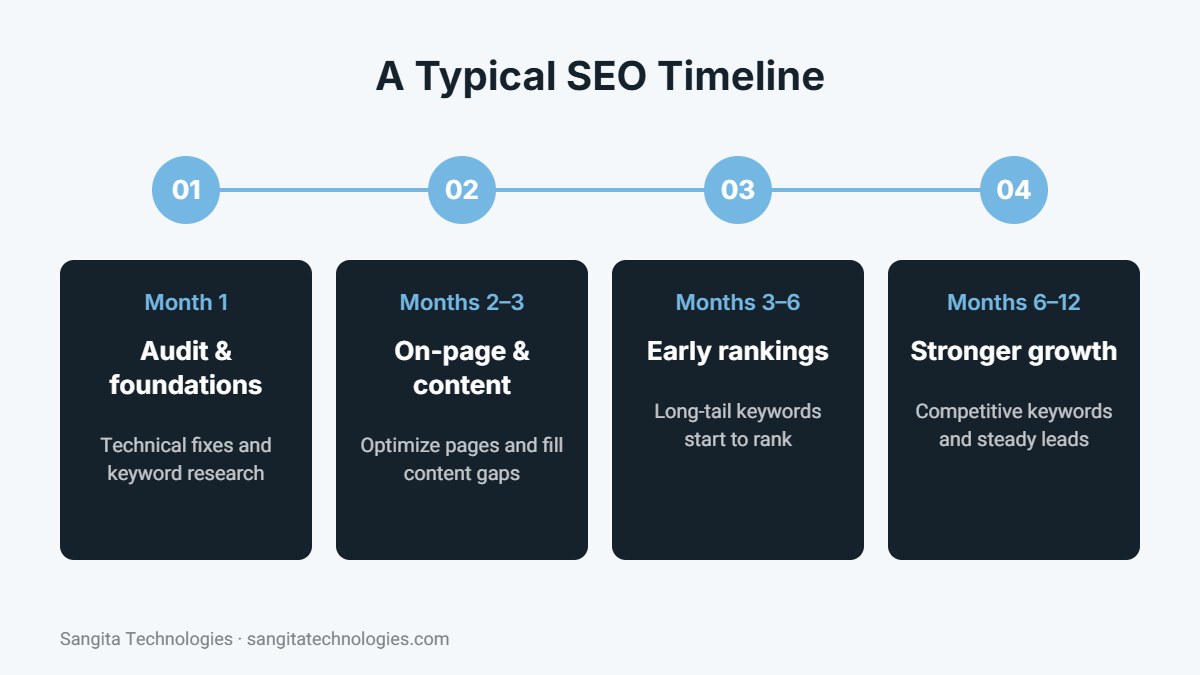
Month 1: audit and foundations
The first month is about understanding where your website stands today. A proper SEO audit checks technical health, including indexing, crawl errors, broken links, duplicate content, page speed and mobile usability. At the same time, keyword research identifies the exact phrases your customers use when searching for your products or services, including local terms such as a service plus “in Jaipur”. Fixing critical technical problems early is important, because no amount of content will rank if Google cannot crawl or index your pages properly.
Months 2 to 3: on-page optimization and content
With a clear keyword plan, existing pages are improved. That includes writing better page titles and meta descriptions, restructuring headings, expanding thin content, adding internal links and optimizing images. Where important topics are missing, new service pages or articles are created. For local businesses, this is also when the Google Business Profile is fully optimized. During this stage, Google Search Console usually shows rising impressions, which means your pages are being shown for more searches even if clicks have not grown much yet.
Months 3 to 6: early rankings and traffic
Rankings for less competitive and long-tail keywords typically improve first. These are longer, more specific searches such as “WordPress website developer in Jaipur” rather than “website developer”. They bring fewer visitors individually, but they often convert better because the searcher knows exactly what they want. Many businesses begin to receive their first steady enquiries from organic search in this period.
Months 6 to 12: stronger, compounding growth
With consistent content, link building and ongoing optimization, rankings for more competitive keywords start to improve. Pages that were on page two move to page one, and the website begins to rank for many related searches at once. This is usually when SEO becomes a reliable source of leads, and when the return on investment becomes clear.
What affects how fast SEO works
Two websites can start SEO on the same day and see very different results. These are the main reasons.
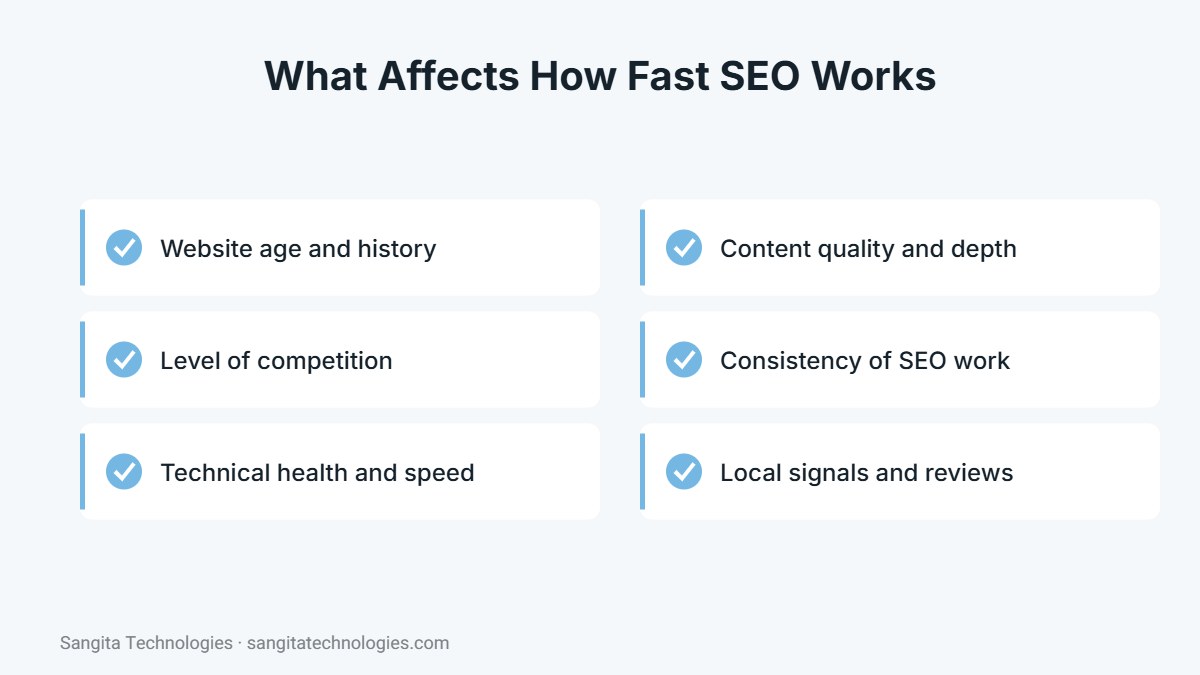
- Website age and history: older domains with some existing authority usually move faster than brand-new websites, which Google has not learned to trust yet.
- Competition: ranking for “SEO services in Jaipur” is much harder than ranking for a niche product in a smaller town. The more businesses investing in SEO for the same keywords, the longer it takes.
- Technical health: slow, broken or poorly structured websites need more groundwork before rankings can improve.
- Content quality: original, helpful content that fully answers searchers’ questions ranks faster than thin or copied pages.
- Consistency: steady monthly work beats short bursts of activity followed by long breaks.
- Local signals: for local searches, a complete Google Business Profile, consistent business details and genuine reviews make a big difference.
How to get SEO results sooner
You cannot force Google to rank you overnight, but you can remove delays and focus effort where it pays off fastest.
- Fix technical problems first. Page speed, mobile usability and indexing issues hold back every other improvement.
- Start with specific keywords. Target lower-competition, high-intent phrases before chasing the biggest terms in your industry.
- Improve pages already on page two. Pages ranking in positions 11 to 20 can often move to page one with better content and internal links.
- Optimize your Google Business Profile. For local businesses, this is often the fastest way to more calls.
- Publish useful content regularly. Answer your customers’ real questions and link each article to the relevant service page.
- Earn quality mentions and links. Directory listings, partner websites and local media help build authority.
- Use Google Ads alongside SEO. If you need enquiries immediately, ads can fill the gap while organic rankings grow.
How to measure SEO progress
Judging SEO by a single keyword can be misleading, because rankings fluctuate daily and results build across many searches. Instead, track a set of indicators every month:
- Impressions and clicks in Google Search Console, which show how often you appear and are clicked in search.
- Organic sessions in Google Analytics, which show how many people visit from search.
- Keywords in the top 10, which show how your overall visibility is growing.
- Leads from organic search, such as calls, WhatsApp messages and form submissions. This is the metric that matters most to your business.
Warning signs of unrealistic SEO promises
Be cautious of anyone who guarantees first-page rankings within a few weeks, offers hundreds of backlinks for a small fee or refuses to explain what work is being done. Shortcuts that break Google’s guidelines can lead to penalties that are far more expensive to fix than doing SEO properly from the start.
Conclusion
SEO is a long-term investment. Expect early signs in the first three months, meaningful growth within six months and stronger, compounding results within a year, as long as the work is consistent and follows Google’s guidelines. The earlier you start, the sooner those results begin to build.
If you would like a clear plan and an honest timeline for your own website, contact Sangita Technologies on +91 97855 41763 for a free SEO review.

Written by the Sangita Technologies team
Sangita Technologies is a digital marketing and web development agency in Jaipur, Rajasthan. Our team works hands-on with local and national businesses on SEO, local SEO, Google Ads, social media marketing, content writing, WordPress and e-commerce development, and shares practical lessons from that work on this blog.
Related services from Sangita Technologies
Sources and further reading
- Google Search Central: SEO Starter Guide
- Google Search Central: Creating helpful, reliable, people-first content
Frequently Asked Questions
Can SEO show results in one month?
Small improvements, such as fixing indexing issues or optimizing a page that already ranks on page two, can show results within weeks. However, meaningful growth in rankings and traffic usually takes three to six months.
Is SEO faster for local businesses?
Often, yes. Local searches in a specific city like Jaipur are usually less competitive than national keywords, and Google Business Profile optimization can bring more calls within one to three months.
Why did my rankings drop after they improved?
Rankings naturally fluctuate as Google tests results and competitors make changes. Look at the trend over several weeks rather than daily movements, and check Search Console for technical issues if a drop continues.
Should I stop SEO once I rank?
No. Competitors keep improving and search engines keep updating. Ongoing SEO protects your rankings and helps you win new keywords.