

Short answer: on-page SEO means optimizing each page’s content and HTML so search engines understand it and users find it useful. Every page needs a clear target keyword, a strong title tag, a unique meta description, one H1, logical headings, helpful content, optimized images, internal links, a clean URL and fast, mobile-friendly performance.
On-page SEO is the part of SEO you control completely. Unlike backlinks or competitor activity, every item below can be improved directly on your own website. Use this checklist when you publish new pages and to review existing ones.
1. Choose one main keyword per page
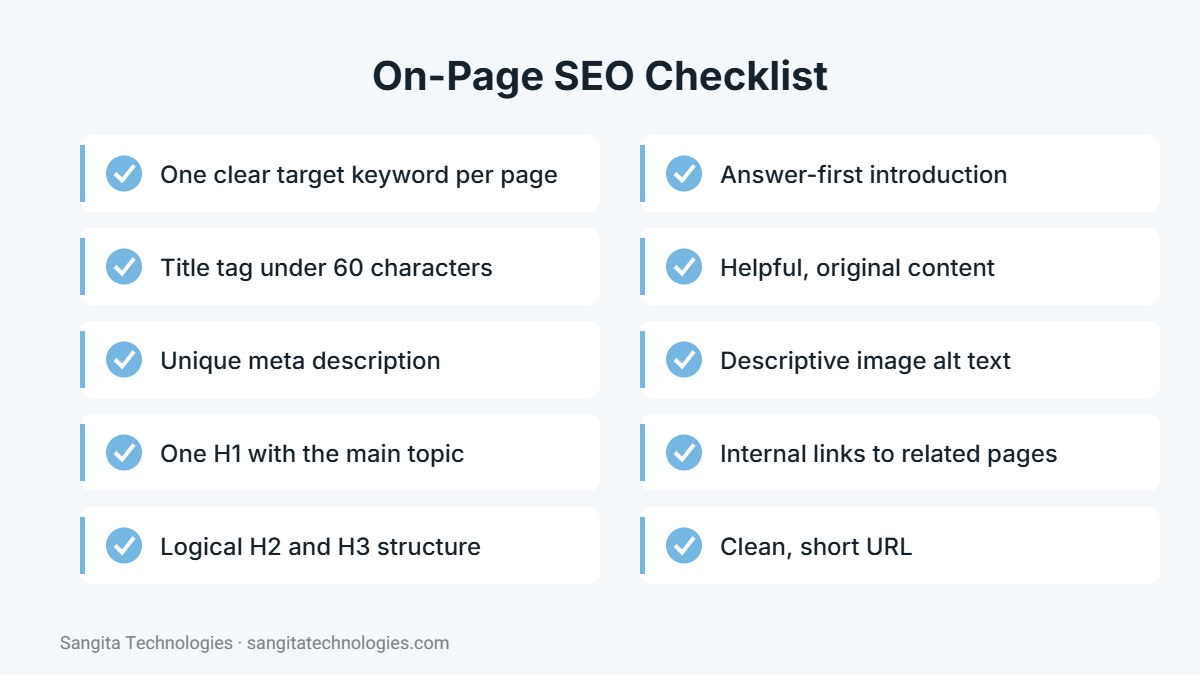
Each page should focus on one main topic and keyword, supported by related phrases. For example, a page about “website maintenance services in Jaipur” should not also try to rank for “SEO packages”. Giving each page a clear focus helps Google understand which page to show for which search.
2. Write a strong title tag
The title tag appears as the clickable headline in search results. Keep it under about 60 characters, include the main keyword near the beginning and make it attractive to click. Every page should have a unique title.
3. Write a unique meta description
The meta description does not directly affect rankings, but it influences whether people click. Summarize the page in around 140 to 160 characters, include the keyword naturally and give a reason to visit.
4. Use one clear H1
The H1 is the main heading on the page. Use one H1 that clearly describes the topic, usually similar to the title tag but written for readers.
5. Structure content with H2 and H3 headings
Break content into sections with descriptive H2 headings and use H3 headings for sub-points. A logical structure helps readers scan the page and helps search engines and AI tools understand the content.
6. Answer the main question early
Start with a short, direct answer to the question the page targets, then add detail. This improves user experience and increases your chances of appearing in featured snippets and AI answers.
7. Write helpful, original content
Content should fully answer the searcher’s question, include specific details and examples, and be written for people rather than search engines. Avoid copying text from other websites or manufacturers.
8. Use keywords naturally
Include the main keyword in the title, H1, introduction and a few headings, along with related terms and synonyms. Do not repeat the same phrase unnaturally, as keyword stuffing makes content harder to read and can hurt rankings.
9. Optimize images
Compress images, use modern formats such as WebP where possible, give files descriptive names and add alt text that explains what each image shows. This improves speed, accessibility and image search visibility.
10. Add internal links
Link to related pages on your website using descriptive anchor text, such as linking from a blog post about local SEO to your local SEO services page. Internal links help users navigate and help search engines discover and understand your pages.
11. Link to trusted external sources
Where it helps readers, link to reputable external sources for data or further reading. This supports your content’s credibility.
12. Keep URLs short and clean
Use short, readable URLs with words separated by hyphens, such as /local-seo-services/. Avoid long strings of numbers or unnecessary words.
13. Add structured data
Schema markup such as Service, FAQPage, Article, Product or LocalBusiness helps search engines understand your content and can enable rich results.
14. Make pages fast and mobile-friendly
Most searches happen on mobile phones. Test pages with Google PageSpeed Insights, fix slow-loading images and scripts, and make sure text, buttons and forms work well on small screens.
15. Include a clear call to action
SEO brings visitors, but the page must turn them into customers. Add clear next steps such as a phone number, WhatsApp button or enquiry form.
How often to review on-page SEO
Review your most important pages every few months, especially if rankings or traffic drop. Update outdated information, improve thin sections and add answers to new questions customers are asking.
How to prioritise on-page SEO fixes
If your website has many pages, it is easy to feel overwhelmed. Prioritise pages that are most important for your business and most likely to improve quickly.
- Money pages first: start with your homepage and the service or product pages that bring in revenue.
- Pages on page two: use Google Search Console to find pages ranking in positions 11 to 20. Improving their titles, content and internal links can move them to page one.
- High-impression, low-click pages: pages that appear often in search but get few clicks usually need better titles and meta descriptions.
- Thin or outdated pages: expand pages with very little content and update information that is no longer accurate.
On-page SEO for AI search
AI tools such as Google AI Overviews, ChatGPT and Perplexity also read web pages to build their answers. The same on-page practices help here: a clear, direct answer near the top, question-based headings, well-structured lists and tables, accurate facts and schema markup. Pages that are easy for people to understand are usually easy for AI systems to understand as well, which increases the chance of your business being mentioned in AI-generated answers.
Keep a simple spreadsheet of your key pages, their target keywords, current titles and the date you last reviewed them. This makes on-page SEO a routine task rather than a one-time project, and it helps you spot pages that need attention before rankings drop.
Conclusion
On-page SEO is a series of small improvements that together make a big difference. Work through this checklist page by page, starting with your most important service pages, and you will build a strong foundation for rankings and conversions.
Want an expert review of your pages? Call Sangita Technologies on +91 97855 41763 for an SEO audit.

Written by the Sangita Technologies team
Sangita Technologies is a digital marketing and web development agency in Jaipur, Rajasthan. Our team works hands-on with local and national businesses on SEO, local SEO, Google Ads, social media marketing, content writing, WordPress and e-commerce development, and shares practical lessons from that work on this blog.
Related services from Sangita Technologies
Sources and further reading
Frequently Asked Questions
What is the difference between on-page and off-page SEO?
On-page SEO covers everything on your website, such as content, titles, headings and images. Off-page SEO covers signals from outside your site, such as backlinks, reviews and mentions.
How long should a page be for SEO?
There is no fixed length. A page should be long enough to fully answer the searcher’s question. Service pages often need 500 words or more, while detailed guides may need 1,500 or more.
Do I need to optimize every page?
Start with the pages that matter most for your business, such as the homepage and main service pages, then work through blog posts and supporting pages.