

Short answer: Google Ads is better when you need leads quickly or want to test demand, while SEO is better for building steady, lower-cost traffic over the long term. For most businesses, the best approach is to use both: Google Ads for immediate enquiries and SEO for sustainable growth that keeps working after the budget is spent.
Business owners in Jaipur often ask us whether they should spend their marketing budget on Google Ads (PPC) or SEO. There is no single right answer for everyone. It depends on your goals, your timeline, your budget, how competitive your industry is and how much each new customer is worth to you. This guide compares both channels in detail so you can make an informed decision.
What is Google Ads?
Google Ads is Google’s advertising platform. You choose keywords related to your business, write ads and set a budget. When people search for those keywords, your ads can appear at the top or bottom of the search results, marked as “Sponsored”. You pay only when someone clicks your ad, which is why it is called pay-per-click (PPC) advertising.
Google Ads also includes Display ads on websites and apps, YouTube video ads, Shopping ads for online stores and Performance Max campaigns that run across Google’s network. For most service businesses, Search campaigns are the best place to start.
What is SEO?
Search engine optimization is the process of improving your website so it ranks higher in Google’s organic, unpaid results. SEO work includes technical fixes, keyword research, on-page optimization, content creation, local SEO and building authority through links and mentions. You do not pay per click, but you invest time and expertise, usually over several months.
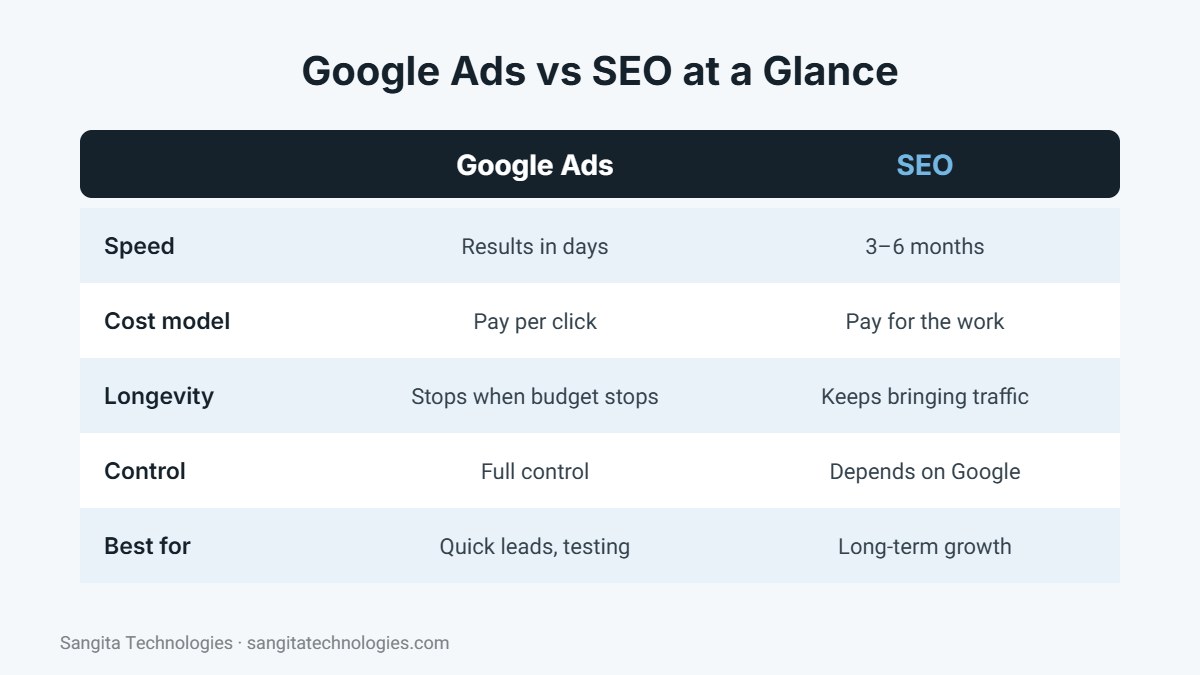
Google Ads vs SEO at a glance
Speed
Google Ads can bring traffic within hours of launching a campaign. SEO usually takes three to six months to show clear results, and longer for very competitive keywords.
Cost model
With Google Ads, you pay for every click, and costs rise as competition increases. With SEO, you pay for the work, and the traffic itself is free. As organic traffic grows, your cost per visitor falls.
Longevity
Ads stop the moment your budget runs out. SEO rankings, once earned, can keep bringing visitors for months or even years, although they need ongoing maintenance.
Control and flexibility
Google Ads gives precise control over keywords, locations, devices, times of day and daily budgets, and changes take effect quickly. SEO rankings depend on Google’s algorithms, so results are less predictable in the short term.
Trust and clicks
Many users trust organic results more and scroll past sponsored listings. On the other hand, ads take the top positions and are very effective for searches with strong buying intent.
When Google Ads is the better choice
- You are launching a new business or website and need enquiries now.
- You run seasonal offers, events or limited-time promotions.
- Your keywords are very competitive and organic rankings will take a long time.
- You want to test which services, offers or messages bring the best leads before investing in content.
- You sell products online and want to appear in Google Shopping results.
When SEO is the better choice
- You want a long-term, lower-cost source of leads.
- Your customers research carefully before buying and read helpful content.
- You serve a local market and want to appear in Google Maps.
- Your cost per click on Google Ads is high compared with your profit per customer.
- You want to build brand authority and trust in your industry.
Why using both works best
Google Ads and SEO are not competitors; they support each other. Here is a simple way many businesses combine them.
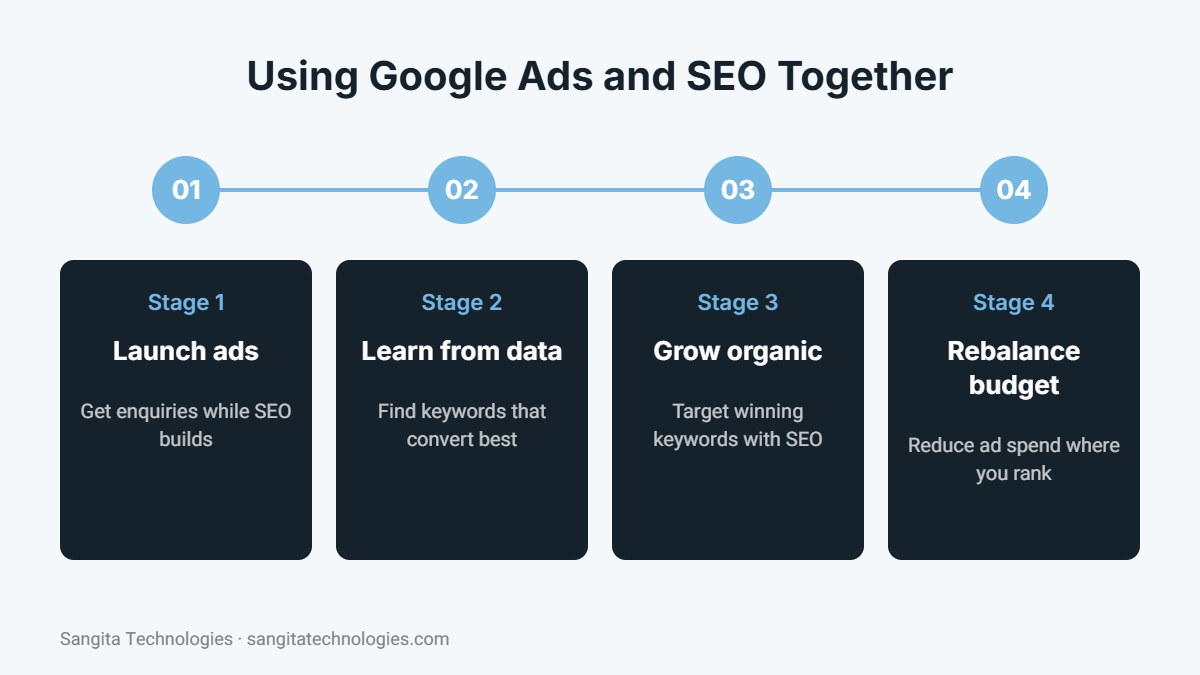
- Launch ads to start getting enquiries while SEO work begins.
- Learn from ad data to see which keywords and messages bring real customers.
- Grow organic rankings for those proven keywords through content and optimization.
- Rebalance the budget by reducing ad spend on keywords where you already rank well organically and moving it to new opportunities.
Appearing in both paid and organic results for the same search also increases your visibility and credibility, which often improves click-through rates for both.
How to decide your budget split
If you need leads immediately, start with a larger share for Google Ads while investing steadily in SEO. If you can wait a few months, a stronger SEO investment usually delivers better value over time. Whatever the split, review results every month and adjust based on data.
Most importantly, track conversions such as phone calls, WhatsApp clicks and form submissions in both channels. Decisions should be based on cost per lead and cost per customer, not on clicks or impressions alone.
Common mistakes to avoid
- Running Google Ads without conversion tracking, so you cannot tell which keywords bring customers.
- Sending ad traffic to a slow or generic homepage instead of a relevant landing page.
- Expecting SEO to deliver results in a few weeks and stopping too early.
- Ignoring negative keywords, which wastes budget on irrelevant searches.
- Treating ads and SEO as separate projects instead of sharing insights between them.
Which option suits your type of business?
The right mix also depends on the kind of business you run. These examples show how different businesses in Jaipur often approach it.
- Local service businesses such as clinics, salons, repair services and coaching centres usually benefit most from local SEO and a strong Google Business Profile, with a small Google Ads campaign for high-intent searches.
- New startups often lean on Google Ads first to get early customers and learn what messages work, while building SEO foundations in the background.
- E-commerce stores typically combine Google Shopping ads for product visibility with SEO for category pages, product pages and buying guides.
- B2B companies with long sales cycles gain a lot from SEO and helpful content that builds trust, supported by targeted search ads for high-value keywords.
- Seasonal businesses such as event services and tour operators can use ads to capture peak demand and SEO to stay visible all year.
Whatever your business type, start small, measure carefully and increase investment in the channel that brings customers at the lowest cost. Over time, most businesses find that a balanced mix of paid and organic search delivers the most reliable growth.
Conclusion
There is no single winner. Google Ads is fast and controllable, while SEO is slower but builds lasting value. Used together, they give you both short-term leads and long-term growth, and each makes the other more effective.
Sangita Technologies manages both PPC and SEO for businesses in Jaipur and across India. Call +91 97855 41763 for a free consultation and a plan that fits your budget.
Frequently Asked Questions
Is SEO cheaper than Google Ads?
Over the long term, SEO usually has a lower cost per lead because you do not pay per click. In the short term, Google Ads can be more cost-effective when you need immediate enquiries.
Does running Google Ads improve SEO rankings?
No. Paying for Google Ads does not directly improve organic rankings. However, ad data can reveal high-converting keywords that you can then target with SEO.
Can a small business afford Google Ads?
Yes. You can start with a small daily budget, target a specific area such as Jaipur and focus on high-intent keywords, then increase spend as you see results.
How soon should I expect results from each?
Google Ads can bring clicks within days and improve over the first four to eight weeks. SEO usually needs three to six months before clear growth appears.